Financial Risk
Financial Risk — Limits, Breaches, and Regulatory Capital
Observeri Financial Risk keeps capital, market, liquidity, and credit risks on one register. Each risk is tested against the limits the organisation defines, from within limit through early warning to breach, and the regulatory capital impact stays on that record.
Limits
Organisation defined
Warn
Before a breach
Capital
Regulatory impact
Financial risk management for enterprises, SMEs, and startups
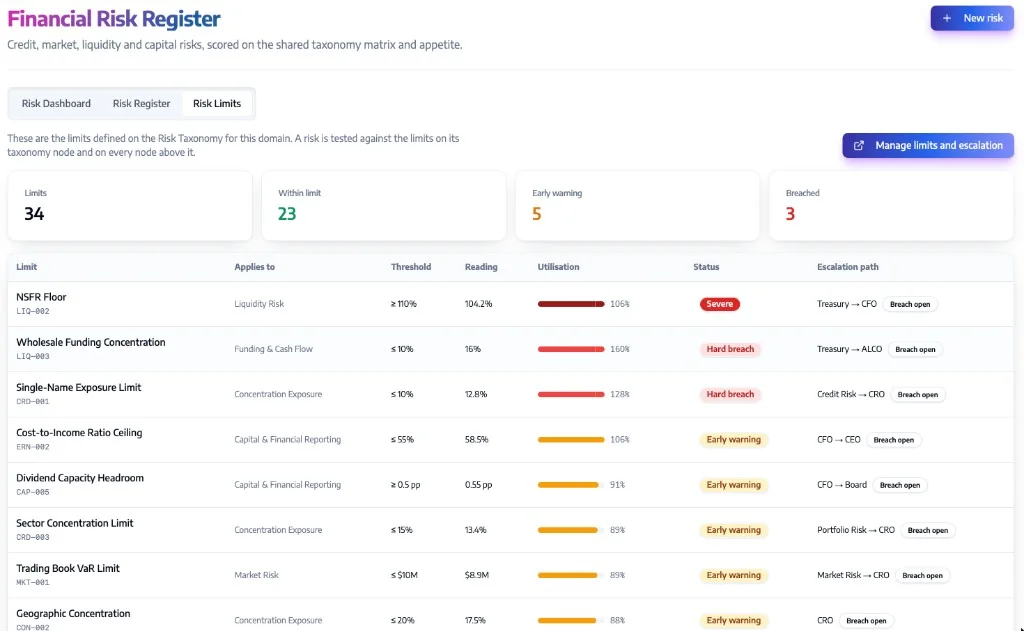
A limit shows its threshold, reading, and utilisation, and it is tested on its taxonomy node and on every node above it. When a warning or a breach opens, the escalation path is already named.
Why it matters
A limit is breached before capital is in the conversation
Capital, market, and liquidity sit apart
Treasury, markets, and finance each keep a book. Nobody sees one position against the limits the organisation actually set.
A reading has no threshold
NSFR, funding concentration, and trading-book VaR are reported as numbers, not as utilisation against a limit.
Warning arrives as a breach
The first signal is that a limit is already broken. There is no early-warning band and no path to the person who must act.
Capital impact is reconstructed later
Regulatory capital is explained after the breach, from a spreadsheet that was not attached to the limit.
The Observeri approach
Test every financial risk against the limit that governs it
One register for the financial book
Capital, market, liquidity, and credit risks share one taxonomy, one appetite, and one place to see the position.
Limits the organisation defines
Each limit has a threshold, the risk it applies to, and a reading. Utilisation is the reading against that threshold, not a separate report.
Early warning, then breach
A position can be within limit, in early warning, or breached. The status changes as the reading moves.
Regulatory capital on the same limit
When a limit warns or breaches, the regulatory capital impact stays on that record, with the escalation path already named.
How it works
From a limit the organisation sets to the capital impact
Register capital, market, and liquidity risks, test each one against its limit, and keep the regulatory capital impact on the same record.
Step 1
Register the risk
Capital, market, liquidity, and credit
Bring capital, market, liquidity, and credit risks onto one register, scored on the shared taxonomy and the organisation's appetite.
Includes
Platform features
What the financial risk register watches
Capital risk
Capital and financial-reporting limits, including headroom and ceilings the organisation sets.
Market risk
Market limits, including trading-book measures, tested against the threshold on that risk.
Liquidity risk
Liquidity and funding limits, with the reading and utilisation against the floor or cap.
Credit exposure
Concentration and single-name exposure on the same register as capital, market, and liquidity.
Organisation-defined limits
Thresholds the organisation sets on the taxonomy. A risk is tested on its node and on every node above it.
Early warning and breach
Within limit, early warning, hard breach, and severe, updated from the current reading.
Escalation path
The route a warning or breach follows, from the risk owner through Treasury, finance, ALCO, or the board.
Regulatory capital impact
The capital consequence of the position, kept on the limit instead of reconstructed after the fact.
Outcomes
A breach carries its capital impact with it
One book for the financial risks
Capital, market, liquidity, and credit are scored on the same taxonomy and the same appetite.
A limit has a status
Leaders see how many limits are within threshold, in early warning, or breached, and which path is open.
Capital moves with the reading
Regulatory capital impact is visible when a limit warns or breaches, on that same record.
Platform capabilities
Limits, status, and regulatory capital
Credit sits on the same register as capital, market, and liquidity. Each risk is tested against the limits the organisation defined, including every limit above it in the taxonomy.
- Register of capital, market, liquidity, and credit risks on one taxonomy
- Limits defined by the organisation, with threshold, reading, and utilisation
- A risk tested against its own limit and every limit above it
- Status of within limit, early warning, hard breach, and severe
- Escalation path opened with the warning or the breach
- Regulatory capital impact held on the limit
- Market, funding, and capital readings monitored as they move
Limit scope
4
Risk domains
Limit
Organisation defined
Warn
Before breach
Capital
Regulatory impact
See the limit before it becomes a capital issue
Monitor capital, market, and liquidity risks against organisation-defined limits, escalate a warning or a breach, and keep the regulatory capital impact on the record.
Frequently asked questions
Which financial risks are on the register?
The register covers capital, market, liquidity, and credit risks, scored on one taxonomy and the organisation's appetite.
How are risks monitored against limits?
Each limit has a threshold the organisation sets, a current reading, and a utilisation. Status moves among within limit, early warning, hard breach, and severe. A risk is tested against its own limit and every limit above it.
Where does regulatory capital impact appear?
The regulatory capital impact sits on the same limit as the reading. A warning or a breach does not wait for a separate capital pack to explain the consequence.
Related products
Cyber Risk Management
Live risk scoring, control mapping, FAIR quantification, and smart remediation.
Operational Risk
RCSA, live KRIs, loss events, and operational capital under Pillar 1 and Pillar 2, with back-testing.
Enterprise Risk
Every risk domain augments one global index, with appetite, limits, breach response, board packs, and live war rooms.
Observeri
AI agent
Welcome to Observeri - My Name is Misha, How may i help you today!
Your privacy choices
We use essential storage to remember your choices. With your permission, we also use analytics to understand website usage and marketing technologies to measure advertising, plus YouTube to show product videos. Optional tracking stays off until you choose. Read our Privacy Policy.