Operational Risk
Operational Risk — Assess, Indicate, Quantify, and Back-Test
Observeri Operational Risk runs the assessment end to end: RCSA, key risk indicators mapped to each risk, loss events, and operational capital. Quantification follows a Pillar 1 minimum-capital view and a Pillar 2 internal view, then back-tests both against the losses that occurred.
RCSA
Self-assessment
KRIs
Mapped to risk
P1 / P2
Capital view
Operational risk management for enterprises, SMEs, and startups
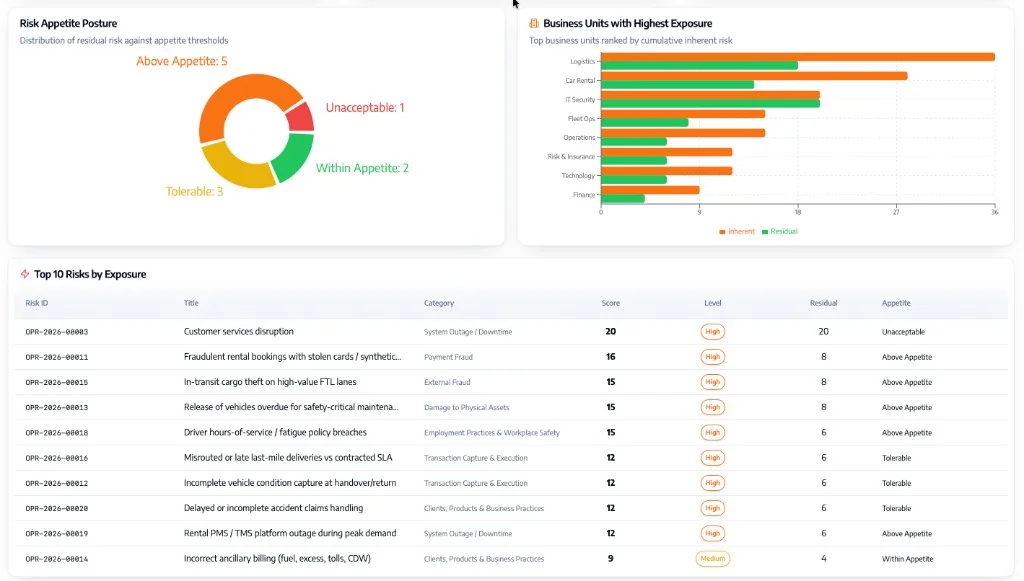
Each risk keeps its business unit, inherent and residual scores, and appetite position. A KRI breach and a new loss event show on that risk, and capital monitoring moves with them instead of waiting for the next workshop.
Why it matters
Operational risk is assessed once and then left behind
RCSA sits in a workshop pack
Inherent risk, controls, and residual risk are scored in a session, then the register does not change until the next cycle.
KRIs are not tied to a risk
Indicators move on a dashboard while the risk they were meant to warn about stays at last quarter's rating.
Losses and capital are separate books
Loss events are logged for finance. Capital and the risk register never see the same event.
Capital is a number without a test
Pillar 1 and Pillar 2 figures are produced, then nobody checks them against the losses that actually occurred.
The Observeri approach
Assess, indicate, quantify, and test on one risk
Assessment through to treatment
Identify the operational risk, score inherent and residual exposure, and keep the treatment on the same record as the business unit that owns it.
RCSA that stays current
Business units assess risks and controls, and the residual result updates the register instead of waiting for the next workshop.
KRIs mapped to the risk
Each indicator is attached to a risk. When the KRI crosses a threshold, that risk shows the breach, not a separate chart.
Capital with a back-test
Monitor operational capital on a Pillar 1 minimum view and a Pillar 2 internal view, then compare both with recorded loss events.
How it works
From the assessment to a tested capital figure
Assess the risk, run the RCSA, map live KRIs, record loss events, and monitor operational capital under Pillar 1 and Pillar 2, then back-test it.
Step 1
Assess the risk
End to end, on one record
Capture the operational risk, the business unit, the inherent score, the residual score, and where it sits against appetite: within appetite, tolerable, above appetite, or unacceptable.
Includes
Platform features
What the operational risk record holds
End-to-end risk assessment
Inherent score, residual score, appetite position, owner, and business unit on every operational risk.
RCSA
Business units assess risks and controls, and the residual result updates the register from that assessment.
KRIs mapped to risk
Live key risk indicators attached to the risk they describe, with threshold breaches shown on that risk.
Loss events
Operational losses tracked and monitored against the risk, the business unit, and the loss category.
Pillar 1 quantification
A minimum operational-risk capital view, held beside the risks and losses that sit underneath it.
Pillar 2 quantification
An internal capital view against the firm's own risk profile and appetite, which can exceed the Pillar 1 minimum.
Back-testing
Capital estimates compared with recorded loss events, so the quantification is tested against what happened.
Operational capital monitoring
Capital watched as KRIs, assessments, and losses move, including which business units carry the highest exposure.
Outcomes
The register, the indicator, and the capital stay together
Appetite is visible by risk
Leaders see which risks are within appetite, tolerable, above appetite, or unacceptable, and which business units carry them.
A KRI moves the risk
An indicator breach shows on the risk it is mapped to, so monitoring is not a chart that nobody connects to the register.
Capital has a loss history
Pillar 1 and Pillar 2 figures sit next to the loss events used to back-test them.
Platform capabilities
Assessment, indicators, losses, and capital
Pillar 1 is the minimum operational-risk capital view. Pillar 2 is the firm's own capital view against its risk profile and appetite, and it can sit above that minimum. Back-testing compares both with recorded losses.
- End-to-end operational risk assessment with inherent, residual, and appetite position
- RCSA by the business unit that owns the risk and its controls
- Real-time KRIs mapped to the risk, with threshold breaches on that record
- Loss event tracking and monitoring, linked to risk and business unit
- Pillar 1 minimum operational-risk capital view
- Pillar 2 internal capital view against the firm's risk profile and appetite
- Back-testing of capital estimates against recorded loss events
- Operational capital monitoring as assessments, KRIs, and losses change
Quantification scope
RCSA
Risk and control
KRI
On the risk
P1
Minimum capital
P2
Internal capital
See operational risk against appetite and capital
Run the assessment and the RCSA, map KRIs to each risk, track loss events, and monitor operational capital with Pillar 1, Pillar 2, and back-testing.
Frequently asked questions
What does the operational risk assessment include?
The assessment records the risk, the business unit, inherent and residual scores, appetite position, and the treatment. RCSA is how the owning unit assesses the risk and its controls, and that result updates the same record.
How are KRIs mapped to a risk?
Each key risk indicator is attached to the operational risk it describes. When the indicator crosses a threshold, the breach is shown on that risk rather than on a separate dashboard.
How do Pillar 1, Pillar 2, and back-testing fit together?
Pillar 1 is the minimum operational-risk capital view. Pillar 2 is the firm's own capital view against its risk profile and appetite, and it can sit above the Pillar 1 minimum. Back-testing compares those figures with recorded loss events.
Related products
Cyber Risk Management
Live risk scoring, control mapping, FAIR quantification, and smart remediation.
Financial Risk
Capital, market, and liquidity risks monitored against organisation-defined limits, with regulatory capital impact.
Business Continuity Management
BIA register, DR and BCP plans tied to it, a crisis war room, and simulated BCP and DR exercises.
Observeri
AI agent
Welcome to Observeri - My Name is Misha, How may i help you today!
Your privacy choices
We use essential storage to remember your choices. With your permission, we also use analytics to understand website usage and marketing technologies to measure advertising, plus YouTube to show product videos. Optional tracking stays off until you choose. Read our Privacy Policy.