Charter and risk register
The mandate and the risks that justify the year sit under the plan, so scope is not a document nobody opens.
Internal audit
Connect the charter, the annual plan, fieldwork, control testing, reporting, and follow-up so assurance advises the business and the action stays attached.
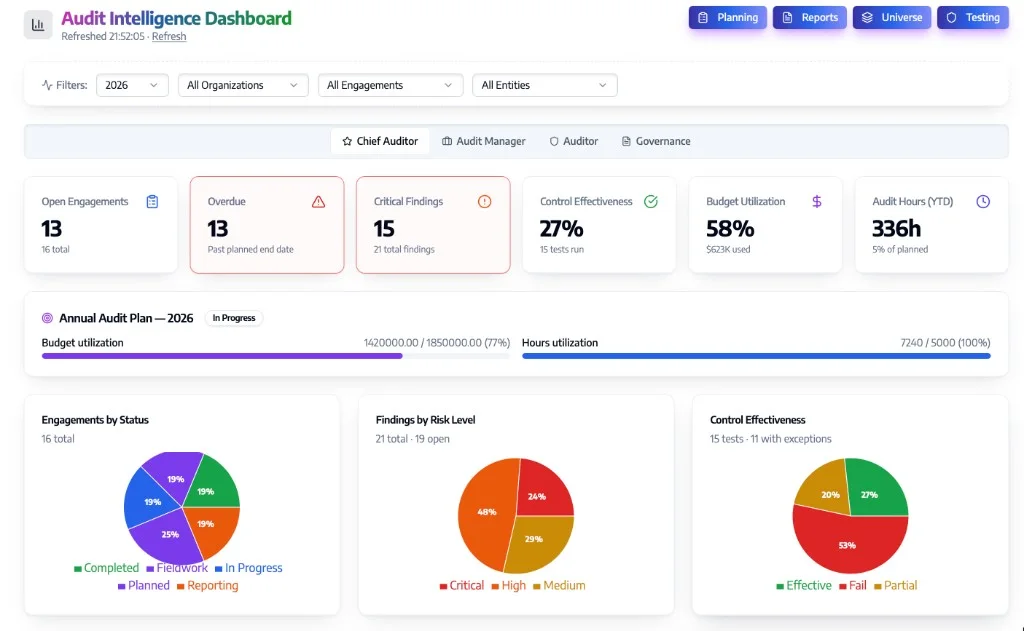
How assurance is held together
The mandate and the risks that justify the year sit under the plan, so scope is not a document nobody opens.
Engagements, hours, budget, and control tests share one record from planning through fieldwork.
The report and the action plan are the same work. A critical finding stays visible until it closes.
The audit lifecycle
Purpose, authority, independence, and scope stay on the function, and every engagement inherits that mandate instead of restating it in a PDF.
The difference
| Audit capability | Traditional internal audit | Observeri internal audit management |
|---|---|---|
| Audit charter | A PDF that is restated, or ignored, when an engagement is scoped. | Purpose, authority, independence, and scope are inherited by every engagement. |
| Audit planning | An annual plan in a spreadsheet, detached from the risks that justified it. | The annual plan and each engagement are built from the audit risk register. |
| Resourcing | Hours are guessed, then discovered when the engagement is already late. | Planned hours, hours used, and budget utilization sit on the plan. |
| Control testing | Tests, exceptions, and findings live in different files. | Design and operating effectiveness, exceptions, and the rating stay on the engagement. |
| Issues and actions | The finding is issued, then the follow-up moves to email. | The follow-up tracker holds owner, due date, overdue status, and closure evidence. |
| Audit reporting | The report is compiled after the work, then the record stops. | Findings, risk level, owners, and the committee report stay tied to the open actions. |
Observeri keeps engagements on one record from planning through reporting. Findings stay open in the follow-up tracker until the action closes, and hours and budget sit on the same plan as the work.
Walk through the annual plan, the engagement, the control tests, the report, and the follow-up on one workspace.
It is the internal audit workspace for the charter, annual plan, engagements, audit risk register, control assessment, reporting, resource and capacity planning, and the follow-up tracker.
The charter records the purpose of internal audit, its authority, its independence, and its scope. Engagements inherit that mandate instead of restating it in a separate document.
The annual plan and each engagement are linked to the audit risks that justify them. When a risk changes, the engagement that addresses it stays visible on the same record.
Resource and capacity planning shows planned hours, hours used, and budget utilization for the year and for each engagement, before the work is already overdue.
Auditors test design and operating effectiveness on the engagement, record exceptions, and rate effectiveness next to the finding, the rating, and the owner.
Reporting records each finding with a risk level and an owner, and assembles the report that management and the audit committee receive from the same engagement.
The finding stays on the follow-up tracker with its owner, due date, and closure evidence. Reporting does not end the engagement; the action remains open until it is closed.
Live risk scoring, control mapping, FAIR quantification, and smart remediation.
KRI/KPI monitoring, policy management, AI budgeting, change management, and project delivery.
Regulations library, AI compliance register, horizon scanning, submissions, incidents, and policy gap analysis.
AI agent
Welcome to Observeri - My Name is Misha, How may i help you today!
We use essential storage to remember your choices. With your permission, we also use analytics to understand website usage and marketing technologies to measure advertising, plus YouTube to show product videos. Optional tracking stays off until you choose. Read our Privacy Policy.