AI Risk Operations Center
One intelligence engine for every signal that drives exposure
The AI Risk Operations Center augments incidents, risks, vulnerabilities, threats, and compliance issues into a single operational view—calculating a live asset risk score for every asset and telling your team exactly where to remediate to protect the crown jewels.
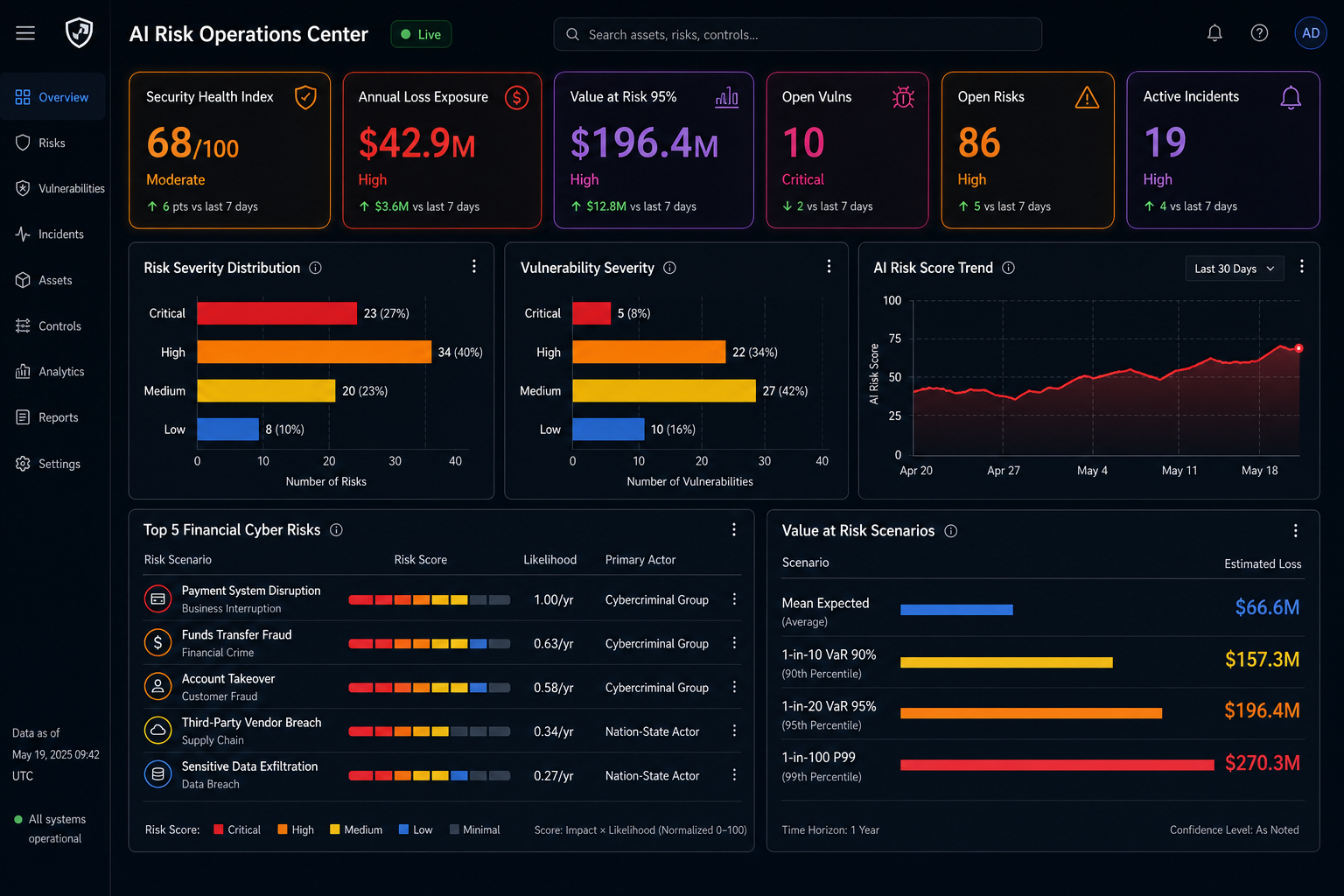
80%
Risk reduction focus
Live
Asset risk scores
24/7
Exposure monitoring
Product overview
See the AI Risk Operations Center in action
Watch how Observeri unifies incidents, risks, vulnerabilities, threats, and compliance into live asset risk scores—with AI-guided remediation that protects your crown jewels.
Why it matters
Security data is everywhere. Risk intelligence is nowhere.
Signals live in silos
Incidents, CVEs, threats, compliance gaps, and risk register entries each sit in separate tools—with no unified view of what they mean for a given asset.
Asset exposure is invisible
Teams know vulnerabilities exist and incidents occurred, but cannot answer how much total risk a specific server, application, or data store carries right now.
Remediation lacks focus
Without correlated intelligence, teams spread effort across low-impact fixes while crown-jewel assets carrying compound exposure stay under-prioritized.
Risk reduction is unmeasurable
Leadership cannot tie security investment to quantified exposure reduction because there is no continuous score that updates as remediations land.
What it is
Continuous risk exposure intelligence for every asset
The AI Risk Operations Center is Observeri's central intelligence hub. It ingests and augments signals from across the platform—incidents, enterprise risks, vulnerabilities, active threats, and compliance deficiencies—then calculates a live asset risk score for each asset in your inventory. Predictive AI surfaces the remediation paths that deliver the greatest exposure reduction, helping teams focus on the 80% of risk that actually matters.
Incidents
Open and historical incidents enrich asset profiles with active compromise context, severity history, and recurrence patterns that elevate exposure scores.
Risks
Enterprise risk register entries map to affected assets—connecting inherent, residual, and treatment status to the systems where risk actually lives.
Vulnerabilities
CVE findings with CVSS, EPSS, and exploit context flow into asset scores—so patch backlog priority reflects real exploitability on each asset.
Threats
Threat intelligence, attack surface visibility, and registered threat actors correlate to assets under active or emerging adversary interest.
Compliance issues
Control gaps, assessment deficiencies, and framework non-conformities attach to the assets and processes they affect—closing the loop between compliance and exposure.
Unified signal augmentation
Live asset risk scoring
Crown-jewel protection
How it works
Aggregate. Correlate. Score. Prioritize. Act.
A continuous intelligence loop that augments every risk signal, scores each asset, and drives remediation toward the 80% of exposure that matters most.
Step 1
Aggregate
Augment signals from every risk domain
Observeri continuously ingests incidents, risks, vulnerabilities, threats, and compliance issues from across the platform and connected integrations—building a unified signal layer instead of fragmented dashboards.
Signal inputs
Platform features
The intelligence engine behind every Observeri module
Cross-domain signal augmentation
Incidents, risks, vulnerabilities, threats, and compliance issues are augmented into one intelligence layer—eliminating blind spots between GRC, SecOps, and vulnerability teams.
Live asset risk scoring
Every asset receives a continuously updated risk score reflecting its current exposure from all connected signal domains—not a static annual assessment.
Crown-jewel identification
Business-critical assets are tiered and weighted so remediation priority always protects the systems and data that matter most to the organization.
80% risk reduction targeting
AI prioritization focuses remediation on the subset of issues driving the majority of enterprise exposure—delivering measurable risk reduction without chasing every low-impact finding.
Automated assessment triggers
When asset exposure crosses defined thresholds, Observeri launches the right assessment or review workflow automatically—keeping governance aligned with live posture.
Executive-ready exposure views
Board and CISO dashboards show asset risk trees, exposure trends, and remediation progress—translating operational signals into leadership decisions.
Benefits for your organization
Continuous risk exposure that focuses remediation and protects what matters
Focus remediation where it cuts the most risk
Instead of equal attention across thousands of findings, AI sequencing directs teams to the fixes that collapse the most exposure—targeting up to 80% of organizational risk with focused effort.
Protect the crown jewels first
Crown-jewel assets carrying the highest business value and data sensitivity always surface at the top of the queue—so critical systems never hide behind low-priority noise.
Continuous exposure, not periodic snapshots
Asset risk scores update as patches land, incidents close, threats evolve, and compliance gaps remediate—giving the organization an always-current picture of residual exposure.
One view for security, GRC, and leadership
Incidents, risks, vulnerabilities, threats, and compliance issues converge into a single operational intelligence engine—so every team works from the same exposure truth.
Measurable risk reduction with less effort
Organizations report up to 80% risk reduction by prioritizing remediation through AI-guided sequencing—achieving more exposure collapse with fewer wasted cycles on low-consequence fixes.
Crown-jewel assets stay protected under pressure
When attack surfaces expand or incident volume spikes, crown-jewel tiering ensures the assets that carry the most business consequence receive immediate attention and sustained monitoring.
Investment decisions backed by live data
Budget and resource allocation tie directly to quantified asset exposure and predicted risk reduction—so leadership funds what moves the needle, not what looks busy.
Platform capabilities
Enterprise risk intelligence at the core
- Unified augmentation of incidents, risks, vulnerabilities, threats, and compliance issues
- Continuous asset risk score calculation for every asset in the inventory
- Automatic score recalculation when patches, remediations, and control fixes are applied
- Crown-jewel asset tiering with elevated exposure weighting and priority routing
- AI remediation sequencing targeting up to 80% organizational risk reduction
- Predictive AI recommendations for risk treatment and security budget allocation
- Automated assessment triggers based on configurable exposure thresholds
- Control mapping with gap detection and remediation routing to Focused Remediation
- Before-and-after exposure tracking to measure remediation impact per asset
- Executive asset risk tree visualizations with drill-down to underlying signals
Quantified outcomes
80%
Targeted risk reduction
5
Signal domains unified
100%
Assets scored continuously
24/7
Exposure intelligence
80% risk reduction principle
Most organizational exposure concentrates in a minority of assets and findings. The AI Risk Operations Center identifies that critical subset—protecting crown-jewel systems and directing remediation to collapse up to 80% of total risk with focused, measurable effort.
See every asset. Score every exposure. Fix what matters.
Unify incidents, risks, vulnerabilities, threats, and compliance into one intelligence engine—with live asset risk scores and AI-guided remediation that protects your crown jewels.